Monday, June 1, 2020

X2019 Overview Google Sheets Checkbook

Why spend time building your own version of quicken to manage your money?
Because you are a nerd and nobody will let you tweak things just how you like it, and you want features that quicken or mint or yodlee moneycenter or ynab (you need a budget app) does not offer - like forecasting account balances for example, or you are cheap and cannot possibly spend money on something to help you track your money better.

It's been about 4 years since the original checkbook article that was somewhat popular - things have changed a bunch and I thought it would be a good time to get into it again. My thinking is I'll write about my own financial life - getting into details as much as possible, focusing on how I make decisions and plans and adjust to changes. I really enjoy financial analysis, forecasting, personal finance type conversations and writing - so it's time to explore that and try to find others that are of a similar mindset. I am married and have 5 young children, I make a normal amount of money - so this should all be interesting stuff to people that are in similar boats.

I still work for the same company as an engineer - I've moved further South and we've finalized our family of 5 little ones (no more children are planned, not that we planned any of the 5 we currently have). Things seem somewhat stable now and I still enjoy spending a few minutes each morning updating my checkbook spreadsheet while sipping on my daily cup of black coffee. My income has increased - I would say I have probably plateaued in my current position and do not expect much income increase for the time being. We have enough and are content in our lifestyle. On Saturday mornings, I typically wake up early and make chocolate chip pancakes for the kids so my wife can get some much needed rest (she still gets awakened by our 2 year old occasionally). After my wife and I eat breakfast we usually spend about 10 minutes discussing our previous budget week (runs Friday - Thursday each week). We talk about how much we spent in each category the previous week and usually go over the details for the miscellaneous category - then talk about if we were over or under budget and how things are going in the bigger picture. My wife and I both enjoy this discussion and it took us several years to get to a point where we could communicate well about money with one another. I'm a logical engineer personality, and my wife is a creative artist personality - so we do not speak each other's language naturally. My one piece of advice to engineer husbands out there, never ever send your wife a graph telling her she spent too much on groceries.

Without further ado - I'll briefly go over the current checkbook format and each tab. I'll be making a template of it available on google sheets if anyone wants to explore it further. I highly recommend building your own spreadsheet as when you build it yourself you will enjoy and understand it fully and learn a lot in the process. I completely rebuilt the spreadsheet in excel after having some issues with it crashing, then shifted it to google sheets later on and have not looked back since. I really like using google sheets - at any point my wife can look at it if she wants (she never does... but she could), and it is in the cloud and does not require a particular computer or even software to access - I can even look at it on my phone although it tends to glitch. Google sheets has come a long way over the last decade. There are a few features I could not move over (VBA programming is not quite the same on google platform) - but for the most part it works very well and any sacrifices are worth the trade-off from excel to google sheets.

This is going to be an overview - I hope to go into detail on the creation of each tab at a future date. Feel free to follow along and create your own - tweaking it as you like.

My current spreadsheet has about 14 active tabs. The most important tab by far is "Checkbook".

The Checkbook tab has an overview of each account at the top and current balances, along with the weekly summary of each category spending, net worth summary and a small section where I keep my kid's virtual bank (more on that later - it's how I teach them about money and encourage saving).


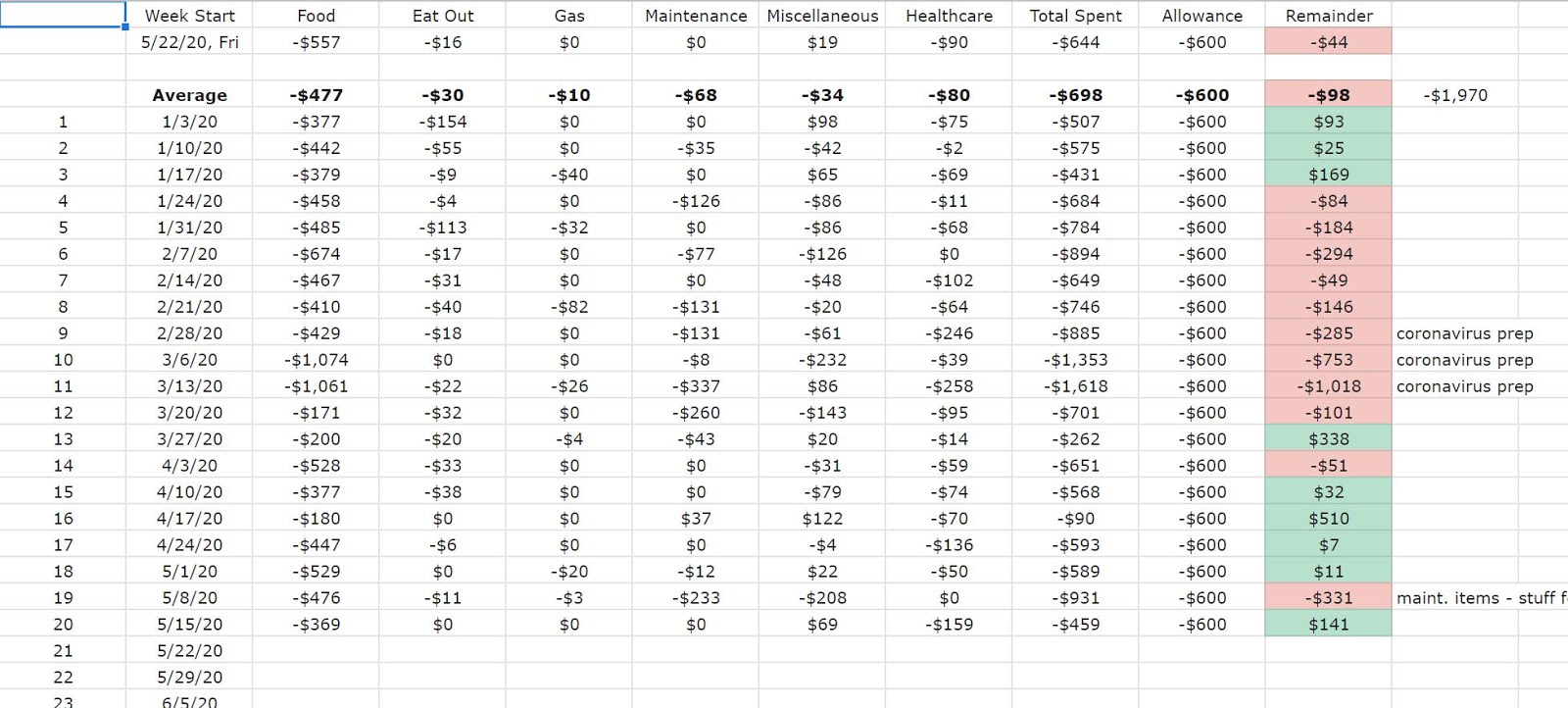
The weekly tab simply records each week and is a good place to notate anything specific for that week, and keeps track of how we're doing for the year on our spending goals.

The Net Worth tab is where I go monthly (after my mortgage is paid) to take a snapshot of my current net-worth. It's fun to track and I've really enjoyed watching how it's been impacted by the covid economy activity. It's also somewhat fun to use it to predict future net worth values - I just use the trend line formula to forecast. The slop is shown as 157 currently, which means on average my net worth increases by 157 per day. This number is slowly creeping up as my investments grow and help to boost my net worth.

The Budget tab is where I tweak our weekly/monthly/annual budget. I also maintain the store and category lists here - when we spend money at a new place I have to pop over here and add the store to the list - this helps when you want to categorize spending by store or category later and you don't have to worry about misspelling it or having multiple occurrences of the same store or category in your checkbook. A budget is pretty simple, you can see the first section is the overall budget - the 2nd section is the annual bigs where I keep track of expenses that happen once or twice annually and the 3rd section is monthly bigs where I track expenses that occur monthly. All of these automatically get thrown into the forecast tab and help to project my accounts balance into the future.


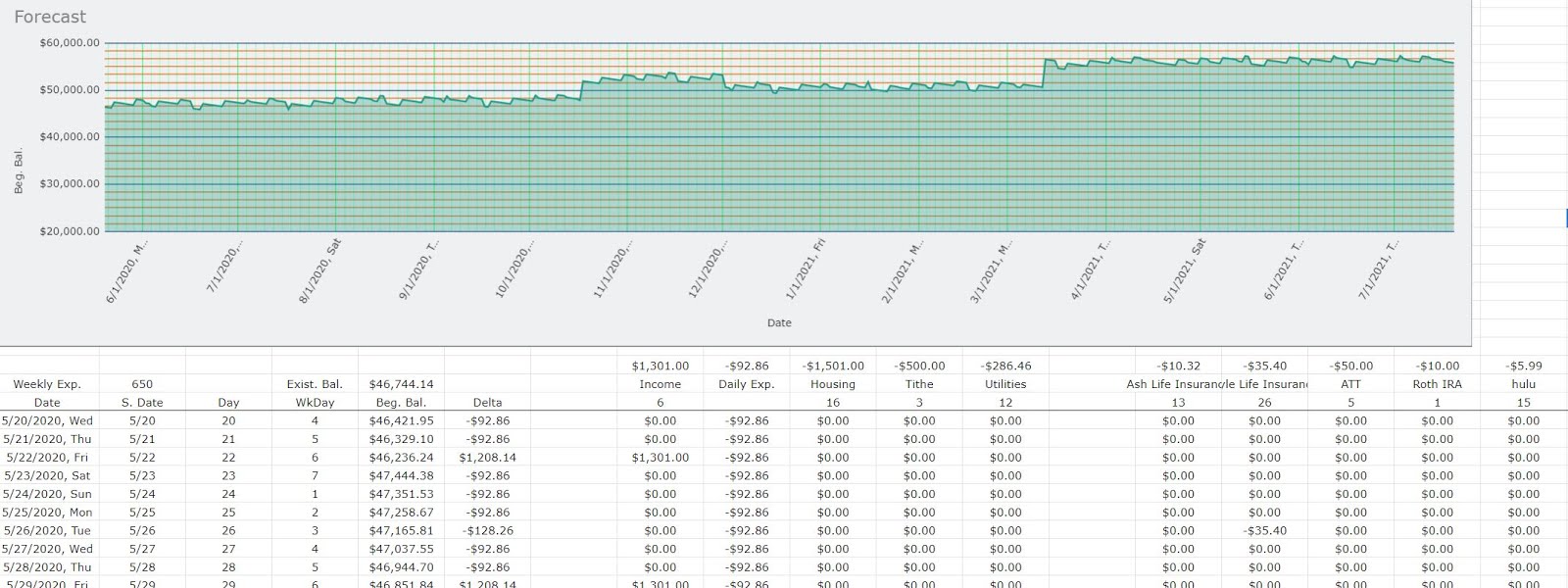
The forecast tab uses my current account balance to forecast forward with budget data as far forward as I want. It's very useful when making decisions especially when you're worried about making large payments in the future like property taxes, insurance and knowing it's okay to spend money now and still having a good margin when the property taxes are due at the end of the year.


The mortgage tab simply keeps track of where we are paying off our home, it automatically throws the current balance into the checkbook and net worth tab to report our current house equity.


The credit tab just keeps track of our credit scores. I find it very interesting how they're impacted by different things.


Bigs is where we keep track of major purchases, or other random things - when we moved my wife and I had agreed to spend around 15,000 on things we would need in our new home. I tracked it here and it's nice to be able to look back and see data on how much we spent on different things when moving here. I also track lawn care costs, vacation costs and some other random things here.


The gas tab tracks maintenance and gas costs for our vehicle. When I sold my last vehicle I added a pdf of the summary and a tally of all maintenance activities to the listing and it really impressed people and made people feel comfortable with my maintenance history and records - I would also argue people are more willing to pay a slight premium or ignore some cosmetic issues with the added documentation. It also tracks oil changes and lets me know when I need to change the oil with some conditional formatting.


The retire tab tracks my investments and helps me think through our retirement plan. It automatically grabs the current stock price on my index funds, I update the quantity of shares when I update my net worth monthly.


Stubs tracks my weekly paycheck and is a good spot to keep track of overal taxes paid annually and notice any changes to my paycheck worth investigating. I use it when checking my w2 during tax season as well.


Archive is where I move my annual transactions at the end of the year, I try to only keep 1 year of data current in my checkbook tab and keep the rest in archive. It seems to move faster that way. This is great for looking up some historic purchase my wife wonders about or if I'm curious when I bought something or for how much, I also look at trends with our category spending over time and this data is invaluable. I currently have a little over 6 years of data.


One cool thing I use this data for is creating an annual financial report every year. I record what our total income was, major expenses (I sort the checkbook from high to low), total spending categorized by store (sort checkbook by store), total spending by category (sort by category), our average weekly spending and other interesting takeaways from the year that helps us to make better future decisions with better data available.

https://docs.google.com/spreadsheets/d/1qPxQ4D_AL5tBmITaULVMHCRi6YCBjEzJS1gONK3pzCM/edit?usp=sharing

Monday, August 8, 2016

Budget Spreadsheet

http://www.budgetsaresexy.com/2016/07/how-spreadsheet-changed-my-life/

I guest wrote this blog on budgetsaresexy last month - it got picked up by business insider and went viral, very cool.

I would like to explore the reasons why I focus on my financial world, and what I’ve learned along the way.
For me, it began when I wanted to spend a substantial amount of money every month for 3 years and I did not know if I could float it.
I graduated as an engineer in 2007, and after 2 years of designing commercial HVAC systems I decided I wanted to shift career paths and move into business by getting an MBA at a local university. It would cost $400/mo for around 3 years. I did not track my expenses at the time, and I had no real clue if I had room in my budget for it or not. I was desperate for information so I could better manage my money.
During my MBA program, the most important thing I learned was that you can only manage things which you measure. If you do not measure, there is no feedback to improve upon.
I researched online and ended up at Crown Financial which got me recording every expense for a month to decide whether I could cut enough out of my budget to add the MBA program in.
I was making about $50,000 at the time. I was single, visiting restaurants with friends frequently, and spent a good deal of my money on pocket knives and frivolous things that did not improve my life, nor make me happy. I wanted to start the MBA program as soon as possible and I could not do these things immediately because I was not managing my money well. This made me upset, and I became determined to become a better money manager.
The reason I focus on my finances is because I want to spend my money on things I value, and to do that I need to manage the money and know where it’s going. I don’t want to spend $0 dollars each month, but I want every dollar spent to go towards things I enjoy. That was the ground breaking epiphany that hit me years after I started getting serious about my financial state.
After a month of recording every expense, I came up with a spreadsheet that let me track things easier than writing them down on graph paper. I started to actually enjoy inputting my receipts into the excel spreadsheet and balancing it with what my bank accounts said. All in an attempt to be a good steward of my wealth and use it in better ways.
After I determined I could do the MBA program, it became even more important for me to continually track my income and expenses since my fluff income was eliminated.
This spreadsheet slowly evolved over the last 6 years. At first it was just a budget template. Now it is a massive workbook that has all of my critical updated information, and is extremely useful to me when making financial decisions.
I started out just wanting to make decisions wisely. Now I open my dashboard and strive to increase my net worth monthly, and make decisions that help it increase faster, instead of only making decisions based on whether I can fit things into my budget or not.
I was single when this started, and now I am financially responsible for 4 young children and a homemaker wife. Knowing where our money is going is security for us. We can anticipate our future and plan accordingly. Our plan is never exactly correct, but having a plan is important and measuring our spending has been critical to actually owning our decisions.

My spreadsheet has 12 major tabs that are used regularly.

Here is a brief breakdown of each, accompanied with a screenshot to see how it looks in action.

Tab #1: Dashboard

This sheet lets me look at my net worth, my account values, and my current budget state. Below the chart is a net worth tracking area I update monthly after I pay my mortgage.
budget spreadsheet dashboard
spreadsheet net worth graph

Tab #2: Checkbook

I input every expense into this sheet and reconcile it with my online accounts daily around lunch time. It gets more difficult to reconcile the longer I wait. I track our budget categories weekly, and close out the week on Thursday night when my wife and I discuss the week ahead.
spreadsheet checkbook

Tab #3: Budget

Figuring out how to keep track of monthly and annual payments this way has been huge for helping me budget accurately. You can see items 4 and 5 are monthly and annual Bigs (they are detailed below)
spreadsheet budget section
spreadsheet annual bigs

Tab #4: Forecast

My spreadsheet knows all of my monthly, annual, and weekly expenses, and will forecast as long into the future as I desire. I quit my mortgage bank escrowing my taxes and insurance monthly, and now I pay my taxes / insurance myself. Doing this allows me to make pinpoint decisions like when we’ll be ready to renovate our kitchen, or how buying a vehicle will impact our resource availability later when we need to pay our home tax and insurance.

spreadsheet financial forecastTab #5: Utility

I have to get my utility budget number from somewhere, so I use the last 12 months average. It’s nice having data so I can compare how installing new furnaces / windows will impact my utility bill, and to also make intelligent decisions regarding return on investment when upgrading appliances as well. I usually note on this sheet when certain things happen each year just to keep track of things.
spreadsheet utility tab

Tab #6: House

This is really just an amortization spreadsheet. Knowing how to do this helped me intelligently compare refinancing options, and showed me how fast changing my mortgage to a 10 year increases our net worth monthly – therefore helping me stomach the pain of eliminating some of my income fluff for good purpose. After seeing the numbers it was impossible to resist. I could talk about this for great lengths, but wouldn’t recommend it without some serious thought. It has added frustration to my life but right now I’m glad we did it.
spreadsheet house tab

Tab #7: Gas

Every time I fill up one of our vehicles, I reset the mileage tracker and record the trip miles and overall miles on the receipts to input here later for posterity. It also tells me when to change my oil.
spreadsheet gas tab

Tab #8: Debt

Our debt has since been cleared, but I assure you there were several accounts here a few years ago while we were steadily hitting them with the snowball method. Here is a snapshot of the last debt we paid off in late November so you can see what the tab looks like:
spreadsheet debt tab

Tab #9: Bigs

I record the expenses on all of our big items (home, pool, van, lawn work, hobby expenses, veterinarian, health and vacations). It’s nice to be able to look back and see things like this. And when you’re selling a vehicle, having this record can justify a higher price.
spreadsheet bigs tab

Tab #10: Retire

This spreadsheet lets me forecast when I’ll be able to retire based on my current actions. I’m aiming for 55 now. The buttons on the right adjust my salary during retirement to keep a minimum balance of 0 by the time I’m 80, 90, and 99. I think planning for a 4% distribution is probably a wiser way to go…
spreadsheet retire tab
spreadsheet retire tab 2
spreadsheet retire graph

Tab #11: Invest

This is just an automatically updated sheet that keeps track of my investments and shoots it back to my dashboard report and retirement calculator. I update the shares weekly by hitting the button to add my weekly investments to the total.
spreadsheet investments tab

Tab #12: College

This lets me calculate how much I need to save for my children’s college. I can hit the button at the top and it will automatically calculate my save/month to make the minimum end balance 0. My current plan involves paying my home off, and then funneling that additional capital over to college savings.
spreadsheet college tab

The Current Situation:

At the end of 2011 I completed my MBA and passed my Professional Engineering exam. I was married in January of that same year, and we had our honeymoon surprise of twin girls shortly thereafter. I was laid off in April of 2012 and ended up in another engineering job I truly enjoy and love.
I used some of the excel skills I learned at my old job, and from constantly tweaking my financial spreadsheet, to solve a really big problem at my new job that quickly caused my salary to increase. I was promoted to senior engineer shortly later and recently accepted another promotion shifting from engineering to management.
We had another child (boy in June, 2013) and our 4th child was just born last month. I’m currently making substantially more than what I was when I was laid off from my old job, and recently was given a company car and enrolled in a golden handcuff program.
Having my MBA turned out to be a key part of why I was promoted to manager from engineering. And tracking my expenses helped get me here.
UPDATE: Within hours this post went viral on Business Insider (over 1.5 million views!!), landed on the home page of Yahoo! Finance, and then went on to hit the top of Reddit getting over 900 comments! Isn’t that incredible?? I knew this was a great post but man… we sure do love our #’s, haha… Thanks again for taking the time, Kyle!

Mortgage Term Return on Investment

Return on Investment
I’ve been digging into what profit really means – and how to use it to make and evaluate personal financial decisions.

One financial decision that has impacted our lives greatly over the last few years was to change our mortgage from a 30yr to a 20yr and then a few years later to a 10yr mortgage.

At the time I looked at total interest paid over the life of the loan and the increase in principal payments over the short term to justify the significant increased risk of tacking a much larger house payment onto our budget, not to mention the discomfort of having to postpone some purchases and adjust our lifestyle to accommodate the larger house payment. In the end I really wanted to have the 15 year mortgage, and that helped push me over the edge to take the plunge.

I made this change a few months before I was married, and my wife at the time was not excited about it. She had lived with a very tight budget for many years prior to our marriage and was looking forward to having some more breathing room in our budget. I had spent a lunch discussing the decision with my father, who agreed with my logic that having a lean budget early on in marriage would be good for us and would teach us to manage our money well and this would pay off for the remainder of our marriage and eclipse any suffering that might occur.

I myself became frantic that I had made a poor decision when my wife gave me the wonderful news that we had accidentally become pregnant on our honeymoon, and then again later on when we found 2 heartbeats in her womb and spent an entire day in quiet reflection realizing our lives would change significantly in 8 months.

Now – 5 years later, looking at moving in the next year or so – I’m so glad we suffered through this. It taught us to budget intentionally and communicate about our money. These skills will follow us through our entire marriage and I now believe the financial discomfort was good for our marriage.

Discussing with a coworker at a previous job his advice was as follows: “There’s something about a 15 year mortgage, you have to pay it off in 15 years.” It’s easy to think that you can just get a longer term mortgage and pay extra down on it, but life happens and you will not. You can easily say the same argument the other way of course, and if you do take the plunge and refinance to a lower term mortgage life will most certainly happen and you could risk having to refinance back to a 30 year loan and pay closing costs again, or potentially having to sell a house you can no longer afford or make other dramatic decisions to make ends meet when life happens.

This is why I would not recommend this to a friend, you have to evaluate the risks and rewards yourself and make the decision. For me, it worked – but it might not work so well for everyone and it could have easily caused us significant problems financially if certain things hadn’t worked out as they had. Now that I’ve framed the article – I’d like to get into some financial details using my actual data.

I purchased my home in July of 2008 for $173,000, at the time I secured a 30yr loan @ 5.5% interest and thought myself one lucky man. This meant I had a monthly payment of $983 with $189 going towards principal monthly. I kept this mortgage for 28 months, paying a total of $29,470 towards the mortgage and only reducing the balance by $6,075. So over 28 months my net worth increased by $6,075. A monthly net worth increase of $217.

I re-financed to a 15 year mortgage on 12/1/2010 at 3.75% interest with a remaining balance of $170,850 after closing costs were included in the loan. Starting out $709 out of a total payment of $1,243 went towards principal. I kept this loan for 43 months, paying a total of $53,426 towards the loan and reducing my balance by $32,555. A monthly net worth increase of $757
For your information there were some circumstances involving home insurance and escrow that made the 3rd refinance seem like a good idea.

On 8/6/14 I refinanced again to a 10 year mortgage @ 2.75% interest. I had a remaining balance of $140,000 at the time and $1,015 out of a total payment of $1,336 went towards the principal. I’ve kept this loan for 25 months so far and have paid a total of $49,423 and reduced the loan balance by $26,083 with an existing balance today of $114,989. A monthly net worth increase of $1,043.

Obviously making this decision based solely on net worth increase is an easy decision if you have enough fluff in your budget to pull it off. I’d like to explore this a bit more and better understand how to balance the required investment vs potential return here.

Let’s pretend there are 3 options to borrow $173,000 on a home and we plan to sell the home after 5 years for $250,000. We will also plan to spend $30,000 on various improvements and maintenance to the home while living there:

Option 1: 30 year mortgage with 5.5% interest
Monthly Payment: $982.27
Initial Principal Portion: $189.36
Total Interest Paid (over 5 years): $45,893.34
Total Payments: $58,936.50
Average monthly increase in Net Worth over 5 years: $217.38
Average Increase in Net Worth / Total Payment: 22.1%
Total Investment: $88,936.50
Total Return: $90,043.16
Total Profit: $1,106.66 (1.24% of investment)
Total Profit / 5 Years (APY approximate): 1.24% / 5 years = .25% / year

Option 2: 30 year mortgage with 5.5% interest (Pay it off as a 10 year)
Monthly Payment: $982.27 + $895.23 extra payment to pay off in 10 years = total $1,877.50
Initial Principal Portion: $1084.59
Total Interest Paid (over 5 years): $37,942.97
Total Payments: $112,650.28
Average monthly increase in Net Worth over 5 years: $1245.12
Average Increase in Net Worth / Total Payment: 66.3%
Total Investment: $142,650.28
Total Return: $151,707.31
Total Profit: $9,057.03 (6.35% of investment)
Total Profit / 5 Years (APY approximate): 6.35% / 5 years = 1.27% / year

Option 3: 10 year mortgage at 2.75% interest
Monthly Payment: $1,650.61
Initial Principal Portion: $1,254.15
Total Interest Paid (over 5 years): $18,467.40
Total Payments: $99,036.65
Average monthly increase in Net Worth over 5 years: $1,342.82
Average Increase in Net Worth / Total Payment: 81.4%
Total Investment: $129,036.65
Total Return: $157,569.25
Total Profit: $28,532.60 (22.11% of investment)
Total Profit / 5 Years (APY approximate): 22.11% / 5 years = 4.42 % / year

As you can see the 10 year mortgage option yields an APY of roughly 4.5% which is decent - and will steadily hammer an increase in net worth over the life of the loan. This data makes it much easier to stomach discomfort associated with a shorter term loan, and might even persuade me to buy less house with a shorter term loan because of the difference it makes on my monthly net worth increase.


Monday, October 1, 2012

Beer Brewing


So I’ve wanted to brew some beer for a really long time now. When I was in college I lived with 7 guys in the basement of the Center for Christian Study and we had a rule in our housing contract that stated we weren’t allowed to bring alcohol onto the property if we were going to live there. Eventually I stumbled upon a pretty easy recipe to make wine out of a gallon sized milk container, 2 cans of welches concentrated grape juice, a balloon, some sugar and a 75 cent packet of wine yeast. After this discovery we spent a good bit of time trying all sorts of variations on the original – trying different fruit concentrates, different amounts of sugar, etc. I had a blast, and we drank wine during every meal.

After college I didn’t think much about it, but eventually I got a bug in my head to try brewing beer and I begged my wife over and over again to bless my endeavor. She never really liked the idea, and still doesn’t – but she said I could do it, and I found a deluxe kit on craigslist for 100 bucks that had everything I needed to brew some beer. A friend gave me an extra “Smashing Pumpkin Ale” kit he had acquired, I bought some yeast from a local brewery and last Saturday I woke up at 6 and started my first brew.
1: I boiled about 5 gallons of water for 10 minutes in the kettle to make sure it was clean and made a santizing soak in my bottling bucket to begin sanitizing everything that would touch the beer wort. I sanitized everything for about 10 minutes, and placed everthing on a saran wrap covered pan to keep it clean – prior to using everything I would again dip it in the sanitizer solution and shake it off. Keeping everything extremely sanitary is the most important part of brewing a good beer. Beer is made from beer wort – which is a perfect environment for beer yeast to live and reproduce in, and also all other types of bacteria – so it’s important no other bacteria are present.

My daughter Esther helping me :) 
2: After sanitizing everything I kept 3 or so mason jars full of the boiled water to cool and began boiling my 2.5 gallons with the hops (1/2lb briess caramel 40) in a large mesh bag to steep till the water reached 170oF. Once my mason jar of clean water had cooled to 70Of I re-activated my dry yeast in it, and covered the contained in saran wrap while I got the wort ready for the yeast.

3. Once the water and the hops had gotten to 170o I removed the hops (took about 18 minutes).

4. After the hoppy water got to boiling – 212o, I removed the pot from the heat and mixed in 1 can of pumpkin, 3 pounds of amber malt syrup, a small packet of cluster hops (1oz) and 1lb of pilsen dried malt extract.

Fermenting Beer in my Glass Carboy
5. After boiling for 45 minutes I stirred in my remaining  3 lbs of amber malt syrup.

6. After 60 minutes of boiling I mixed in 2 teaspoons of pumpkin pie all spice and put the pot of wort in an ice bath in my sink and put a sanitized bag of ice in the wort to cool it as quickly as possible from 212oF to 70oF. It took about 30 minutes, and a lot of stirring and replenishing cool water from the faucet – I also used all of the ice in the freezer.

7. I filled my 6 gallon glass primary fermenter carboy with 2 gallons of cold tap water and then syphoned the wort from the kettle to the primary fermenter. I pitched my previously prepared yeast into the fermenter and filled it up to the 5 gallon mark, filled my bubbler with a little vodka and sealed the fermenter and moved it to my closet. It started fermenting after about 12 hours.

8. Once the bubbler stops bubbling fermentation will be complete, after about a week and I will move the brew from the primary fermenter to the secondary fermenter to prevent the dead yeast cells from giving the beer an off flavor.
Testing the Gravity after pitching Yeast

9. After a couple of weeks in the secondary fermenter I’ll syphon the beer from the secondary into my bottling bucket with the attached spout and mix in a little bottling sugar that the remaining yeast will use to carbonate the beer when it’s in the bottles.

10. After bottling and aging in the bottlles for a couple weeks at room temperature the beer should be ready to drink. Wallah.

This will produce about 5 gallons of beer, or 48 bottles. Northernbrewer.com sells kits for anywhere from 20-30 dollars a piece, making the beer cost somewhere between 40 cents and 80 (60 cents average) cents a piece.

The starter kit costs anywhere from 80-200 depending on how advanced you get. Nicer beers cost anywher from 8-10 bucks for a 6 pack, 1.33-1.67 (1.5 average) per beer – showing a savings from .90 each.

My kit cost 100 bucks, which makes the investment pay back in about 112 beers – or less than 3 brews. That’s really not a reason to do it – but I like it.  
Fermenting in my closet after 12 hours

Tuesday, September 18, 2012

Transitions - Laid Off


I meant to write an article about this a long time ago, but I ended up getting rather distracted and never putting it together. This is an article about getting laid off in March of this year and how I transitioned to my new job a few weeks later.

 First off – getting laid off was not the only thing going on in my life when it happened. I was married in January of 2011 to my sweet wife Ashley (my greatest accomplishment in life was wooing her heart over our short dating/engagement period of about 6 months). I registered to take the professional engineering exam in April of 2011 – and found out my wife and I were pregnant with twins shortly before that. I was scheduled to sit for the professional engineering exam (an 8-hour full day test I had been dreading from the time I was first made aware of it in college) on October 27th. My baby girls were officially due on October 13th, and I was also finishing out my Masters in Business Administration in December of 2011. The twins were born on 9/23/11, I took my P.E. on 10/27/11 and graduated with my MBA in 12/2011. I heard back that I had passed the P.E. in December as well. I was laid off 3 months later in March of 2012.

Adding to all of this, I had bought a foreclosure in Collierville which was well-known as a bachelor pad for most of the 3 years prior to me being married. With the aid of my father, we furiously spent our weekends attempting to make my bachelor pad into a home suitable for my family prior to Ashley’s due date.


 Now that I've set the scene:

 I was already aware that my company was doing poorly – work got slower and slower and it was tough to stay busy. Our department was seemingly way overstaffed and from what I could tell the company had been poorly managed for some time. I had started as an intern in 2007 and had been working for around 5 years when a board member walked over to my desk and asked me to come with him. I joined 2 younger engineers from different depatments and instantly realized I was being laid off as I could think of no other reason the other 2 young engineers, two board members and I would all be in a meeting together. My head got hot – stress instantly rose within me and I began frantically thinking about how my life was about to change tremendously.

 There are many reasons for why I was chosen to be laid off, I’m sure – I don’t feel that is relatively important to this article – so I am purposely leaving that out.

Thankfully when I walked into that last meeting at Allen and Hoshall my wife and I had been contemplating for some time paying off her new honda civic and the only reason I hadn’t up till then was because I was worried there would be layoffs soon at my current job. That caused us to have a healthy amount of money in our safety fund and I knew we would be okay for the short term. I was told I would be paid to the end of the month – I think that was about 28 days when you factored in my untaken 2 weeks of vacation pay. Since I was a little worried about layoffs I had recently burned every possible piece of data I might ever want from the company servers onto a collection of 9 dvd’s and had stashed them at home. I had also already been very discontent at my job and had been looking pretty seriously into finding a new job for some time, had met with a technical recruiter who helped me revise my resume and had already looked into several leads unsuccessfully. The very last thing I believe was God’s total favor being that I had stumbled upon an audiobook copy of a book called “what color is your parachute” and had listened to it very closely the previous week. This book is all about preparing for being laid off, and it really helped me to think very critically about my possible plan while I was calm and unhappily employed the week prior to being laid off.
  
Immediately after hearing the news and prior to collecting my things, I called my wife and told her the news. Her reaction astonished me… she simply asked “why did they lay you off?” as she was rather surprised. I told her I wasn’t sure, and I loved her and would be home as soon as I could be. She didn’t sound worried at all, and looking back now I know she wasn’t. She knew the whole time that God had plans much greater than ours. That he knew when he gave us the twins what we would need, and he would be our provider. She simply knew that God watched us closely, and he was aware of our situation. That conversation was the absolute best way for her to help me in that moment and it was exactly what I needed from her. It was amazing and made me smile in one of the darkest looking days I have ever seen.

 I packed up my jeep, and drove home – after a few minutes of total bliss realizing that I would never have to return to my dreaded old job – I prayed out loud for a few minutes then picked up my phone and started calling everyone I knew that might know of anything. I told them my situation, what I was looking for, and asked them to please let me know if they heard of anything that might fit. I had quite a few soft leads after that first day and spent most of that night at home looking online and updating my profile on job search sites and emailing out my new resume with a new fresh cover letter. During the meeting where I got laid off one of the board members had told me he was aware of a couple companies looking for a mechanical engineer and wrote their numbers down for me.

After a couple days, and absolutely exhausting all of my contacts – even posting my situation on Facebook, I had 4 pretty good opportunities lining up. I began interviewing the following Wednesday, and had 3 interviews at companies I wasn’t very excited about before I had scheduled an hour long phone interview with the company I really wanted to pan out. I had actually already sent in my application and spoken with HR at Barnhart about 3 months prior to being laid off, but I had seemingly been brushed off and nobody really told me why. I sent in my resume again, and one of the people I had emailed called me and told me to look at Barnhart. This was one of my favorite MBA professors at Union, Keven Westbrook.

 Amazingly so, Keven had recently started training the sales staff at Barnhart and had a pretty solid relationship with some important people at Barnhart. He called to ask why they hadn’t hired me already, and the human capital VP gave me a call that night and set up the hour long phone interview. During our phone interview I remember him saying if we had gone to college at the same time we would have been best friends. We had very similar background, both coming from reformed Presbyterian churches and our thoughts on everything lined up perfectly. I told him I had a few other offers to look at and he told me he felt pretty certain he wanted me to come to Barnhart quickly, and I could come in the following week for a face-to-face interview.
  
In the meantime I had interviewed with 3 other companies, and had firm offers from 2 – each for substantially more than I was making previously. The stress had already started to subside and excitement was building quickly. My interview at Barnhart was intense, I interviewed with 6 senior engineers for 45 minutes each – and left feeling good about things, but mentally exhausted after telling my story to 6 different highly intelligent men. I took an engineering aptitude test that had 5 questions on it – 3 of which I solved easily and 2 of which I had no idea how to solve but did my best to show I knew how to set up problems really well… I was moving from a background in refrigeration to a completely new field much more kin to steel design and civil engineering type work.

 That Friday Barnhart sent me my official offer letter and I called and accepted. They said I could come to work whenever I liked, I told them instead of coming the very next Monday – I wanted to take another week to enjoy with my wife since I hadn't really enjoyed the prior 2 weeks since I was so stressed.
  
After all of this I don’t feel this is exactly the typical layoff story. I don’t feel anything I did really prepared me for this or helped me to get through it faster. I really think God ordained everything and I am so greatful he had a wonderful plan that brought me to where I am today. I calculated it later – Allen and Hoshall ended up paying me for 28 days after I was laid off – I started at Barnhart on the 29th day. God watches us closely. 

Resume


Yesterday – while listening to a Danny Silk sermon (http://podcasts.ibethel.org/podcasts/follow-your-favor) about finding your favor, I was thinking about how important it is to know that thing you do better than anyone else – and by knowing that to direct your life in a way that you can use that skill or skills as much as possible.

Really this is a lot like learning to write your resume – just instead of trying to use it as an annoying calling card for employers nationwide – you only use it yourself to manage your life. When I was laid off and for a good while prior to being laid off – I spent a little time asking my closest friends to tell me what they thought I was supposed to do with my life. I felt very unhappy with my current job and I spent most of the ride home every day praying that God would remove me from it and give me something new to apply myself to. Typically I would start my prayer with “again…. Please give me a way out of there Lord”…. Wondering why I would pray this prayer every day after work and I still felt trapped and every way out I had tried so far had failed. I struggled with these feelings most of the time I was there – and wavered between trying to “love” my job by telling everyone I was content and happy and hoping these feelings would just become my actual feelings and being miserable and feeling trapped forever in this job. I do feel this prior job had an important purpose in my life, and I wouldn’t change my past – but God’s timing is always perfect and I know I will continue to learn better and better to just trust Him and stop struggling so much to control everything.

Anyways, I believe God uses time to generally move his people towards the things they are meant to do with their life – I think often we fight that flow by trying to organize our life ourselves and not listening to God’s voice or our friends and family who tell us what we shine at. I feel in retrospect that if I had taken time to look hard at my own interests and what made me feel passionate instead of worrying about income and what other people wanted to do with their lives, I might have noticed sooner that my old job was not where I was supposed to be. I tried to make myself fit into that job – but really I should have realized that I needed another, my old job was only a stepping stone to something else.

When you write your resume, you put everything in there that will convince this employer that you are absolutely a must-hire. When you think about your own future and your personal resume, look at what it is in your life that you get excited about. What makes you want to stay up late exhausted working on? What makes you want to jump out of the bed in the morning when you realize excitedly what is waiting for you. Work is something that should be wonderful – it isn’t something we should dread. Sure – sometimes we have to do things we don’t want to because we’re working towards an ultimate good, but I sure don’t want to dread waking up every day for the next 38 years – I’d rather just sell everything I own and go get a hotel in Peru for 35 cents a day. Guinea Pigs are cheap and a delicacy – and the view is spectacular. 

Monday, September 17, 2012

Engineer Budgeting


First of all I know this borders on being OCD – when I talk about this people roll their eyes. I think it’s important and I enjoy doing it – I’m sure there are easier ways of getting the same kind of accuracy. I don’t think everyone needs to be this precise, but I thought it would be a fun article to write and non-engineers might find it amusing. I use Yodlee.com quite a bit – it does a snapshot type deal of all your financial accounts and keeps track of bills. I’ve used it for years and love it. You don’t have to visit each site, but just log in here and it shows you a dashboard of everything. As far as security is concerned yodlee probably already has your log on information since it manages this for many large banks and it’s security record is stellar.

One of my passions in life – embarrassingly so sometimes, is that I love watching and keeping track of my finances meticulously. I never really cared much about money growing up, I did have a small lawn-mowing gig growing up where I did make a lot of cash – at least 15 year old Kyle thought it was a pile… but other than that, I pretty much grew up with my parents providing what I really needed and I got a lot of what I wanted by begging or mowing grass.

The real lane changer financially happened during my senior year of college. I had an opportunity to sign up for a class called “Personal Finance” that only 4th years were allowed to take due to the high demand. I was a little worried about my future – knowing in the next year I would suddenly have a lot of financial responsibilities with very little financial know how. I would watch my parents balancing checkbooks and paying bills and I never really took the time to ask about the specifics. Regardless, I felt very unprepared going in to this class for my post-college financial world.

An older lady taught this class, and she was very thorough in her methodology. She taught us all the basics, simple budgeting, 401k, Roth IRAs, Mortgages, Interest Rates, the future value of money – I was stunned. We did everything in excel and she made us make pretend budgets and keep track of our spending and create reports and in the end I felt pretty confident that I knew how to manage my finances as an adult.
In my first job – I started as an intern and while they kept me pretty busy doing busy work I would eventually run out of stuff to do and have to wait for an older engineer to give me more work.

During this time I couldn’t really “not work” and had to work pretty hard at staying busy. Since I did work in spreadsheets often, I started working on creating a more useful spreadsheet to keep track of my finances. I started with something simple I pulled off of crown financial and it quickly got very complicated, then I would spend hours making it simpler and adding features as my needs got more and more complicated with time. I liked the idea, but since I was single and living at home I really didn’t need to budget very closely – I had plenty.

After a few years, the economy started to stutter and my company lowered our salaries by 10%, I had already begun the process of applying for an MBA program that would add a substantial increase to my monthly bills, so I felt very unsure about things financially and decided to forego the MBA and hope the 10% returned soon so I could get back on track with getting an MBA.

Today Kyle knows – that because I did not keep a close eye on my finances that uneasiness was really rather conservative. Eventually I was told by the MBA program that if I did not sign up by the following semester I would have to take an extra semester of pre-requisites to qualify for the MBA program. So I buckled down for a few months and started inputting each receipt into my spreadsheet so I would know if I could handle the $650 increase in expenses each month for the two and a half years it would take to finish the MBA. After that I never stopped putting every receipt into the spreadsheet – sorting them into fixed expenses and non-fixed, and then into all the different categories they could be. Doing so allows me to understand where the money goes and knowing where the money goes allows me to make intelligent decisions about how I spend my money daily.

It does not make much sense to try to explain the spreadsheet – I decided I would just post a default one (I used a make-up salary of 30,000 and made up everything else on it… FYI), so if anyone wanted to play with it they could. My old job paid salaries on the 1st and 15th, so I had structured the budget into a monthly budget tab. My current job pays our checks every Friday, so now I switched to a weekly budget.

Download Link: (It does have macros in it, so you'll have to enable them to use the cool button features)

There are 7 tabs in the spreadsheet:


Budget – where a weekly budget is kept, at the end of the week you simply push the “Next Week” button and the excel sheet automatically creates a new week and moves any excess “Banked” money in the budgets to the next week. This way you can watch your banks – when they grow or shrink too much you can adjust your budget to be more accurate in the long term – or know you need to move money from one category to another.


Summary – Summary simply keeps track of your monthly low point financially, for me this occurs right after our mortgage is taken out. I like knowing this because if something does happen – say I get laid off, I know I have that much money clear and free at any point during the month. I try to keep a nice big safety fund in there (When I was laid off in March it took a lot of stress out of my life). It’s also a good measure of how each month went – if the summary gets bigger and bigger then things are well, if you continually lose money then your budgets are working out correctly.


Utility – utility keeps track of utility bills, I did a lot of energy conservation type work in my old job and found it extremely interesting to track my utility bills and notice how it changed with the seasons, or when I made an improvement like installing insulation upstairs or adjusting thermostat settings. I also compared my utility bill costs – kwh/sqft or therms/sqft to national averages to see where my house stood. If there is any interest I can talk about this more later.


 Annual Bigs – Annual bigs is the tab that keeps track of anything big that happens once a year, like insurance costs, vehicle tags, life insurance, cell phones, gym memberships – stuff like that. I also use this sheet to keep track of home repair costs, vehicle repair costs and some other etcetera stuff I like to record for posterity’s sake.


Mortgage – this sheet keeps track of my mortgage, I actually molded another person’s spreadsheet to this and it keeps track of extra payments made… stuff like that. Pretty self explanatory. I ended up making the decision to switch to a 15yr mortgage right before I got married… because I keep so close track of my finances – I could make an intelligent decision, know that I was capable of doing it – and it will save us a ton of money in the long run. I should have the house paid off a few years before the twins enter college, which will be helpful…


Retirement – this sheet simply keeps track of retirement, the cool feature here is that you can adjust what your pre-retirement interest rate (I used 8%) and your post retirement (4%) and see how that affects your retirement salary – it will automatically calculate this by giving you a inflation raise every year and depleting retirement by the time you’re 99.


DebtsPlan – the sheet is used to plan debt pay offs, it’s very simply created. Just pay off one debt at a time and watch the debt disappear.